
Humor OS — Relational Sense × Variation
A humor operating system for reading distance, hierarchy, intimacy, publicness, and safety margin before twisting expectation through content or delivery.
LIFE OS — Humor 003
Humor OS is not a library of funny lines. It is an operating system for reading the relationship, finding the expectation, and twisting meaning or delivery inside a safe margin.
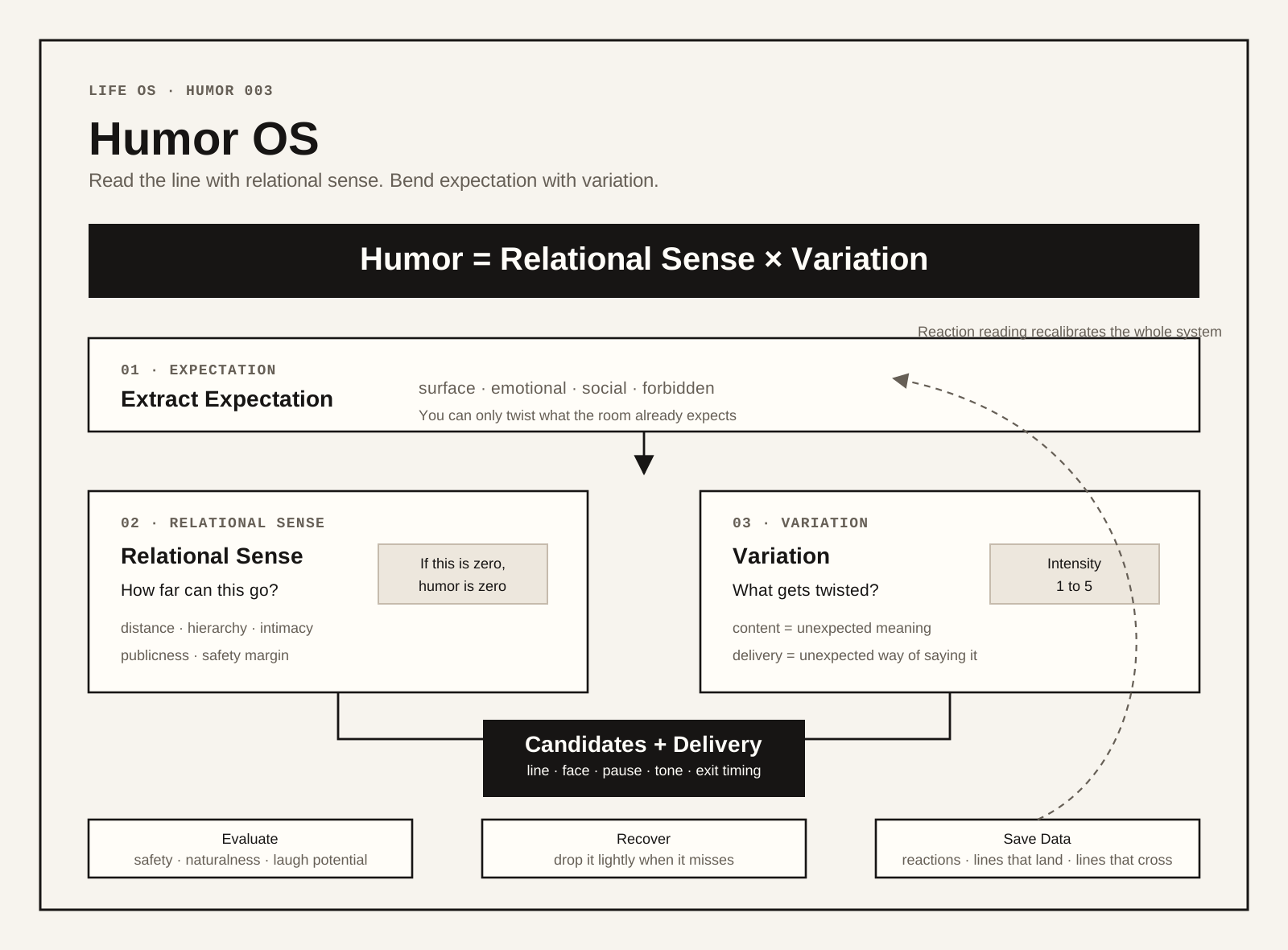
One-Line OS
Good humor reads the relationship, secures safety margin, then lightly twists expectation through content or delivery.
The practical formula:
Humor = Relational Sense × Variation Read the room, then bend the expectation
Relational Sense = distance + hierarchy + intimacy + publicness + safety margin

Variation = content variation + delivery variation

Content variation = unexpected meaning

Delivery variation = unexpected way of saying it
The multiplication matters. A clever twist with zero relational sense becomes rudeness. Strong relational sense with no variation may be pleasant, but it rarely creates laughter.
The Core Shift
| Trying to be funny | Operating humor | |
|---|---|---|
| First question | What line should I say? | How far can this relationship safely go? |
| Expectation | Weird equals funny | You can only twist a visible expectation |
| Intensity | If it laughs, it works | It must be recoverable if it misses |
| Target | The other person’s traits | Self, situation, mood, shared reality |
| Delivery | Think only about the words | Face, pause, tone, and exit timing matter |
Humor is expectation violation. But people do not only expect content. They also expect a face, a rhythm, a level of seriousness, a gaze, a pause, a posture, and what you do right after the line. That is why humor has two layers.
- Content variation — say a meaning people did not expect.
- Delivery variation — deliver it in a way people did not expect.
Good humor combines those layers inside relational sense.
The Map
Humor OS runs through this sequence:
Summarize the situation
→ Read relational sense
→ Extract expectations
→ Design content / delivery variation
→ Generate candidates
→ Evaluate safety and naturalness
→ Select the best three lines
→ Prepare recovery lines
→ Save reaction data
This is not meant to be recited mechanically. In live conversation it compresses into a fast instinct. In training, you slow it down so the instinct can form.
1. Relational Sense
Relational sense is not merely being nice. It is the ability to know whether this twist can be received in this relationship, in this room, at this moment.
Distance
A first meeting, a light acquaintance, a close friend, a date, a colleague, a boss, family, and an online chat all carry different distance. The farther the distance, the lower the variation intensity. With someone new, light observation, self-directed humor, and situational metaphor are safer than sharp reversal.
Instead of making the other person responsible for the silence, say: “My conversation engine is still warming up.” The same awkwardness is handled, but the cost moves to you.
Hierarchy
When hierarchy is present, do not twist the person above you directly. A boss, client, evaluator, or senior person has face to maintain. The bigger the hierarchy gap, the safer the target should become: yourself, the situation, the system, the schedule, the meeting, the weather.
“That is too much” can feel like resistance. “My calendar just started praying quietly” says the same pressure without attacking the person.
Intimacy
Intimacy is the credit limit of joking. If you have already exchanged playful lines, if the other person knows your tone, and if laughter has already appeared, you can raise intensity. If trust is low, use a weak line with a stronger delivery variation.
With low intimacy, a small sentence delivered too seriously often works better than a sharp sentence delivered directly.
Publicness
One-on-one is different from being in front of people. The more public the room, the more face is involved. In groups, avoid the person’s mistake, appearance, competence, recent failure, or anything that leaves them alone paying the cost of the laugh.
In a group, shared-situation humor is safer: “I think we are all looking at the same file from different universes.” No one is singled out.
Safety Margin
Safety margin is the amount of room left if the joke misses. Lower intensity when any of these are true:
- The line attacks the other person directly.
- It would be hard to recover if it fails.
- The other person has no easy way to play back.
- The intensity is too high for the relationship.
- It approaches appearance, money, education, family, age, gender, politics, religion, trauma, performance, or romantic history.
- Delivery cannot soften the line enough.
- The better move is not joking.
When safety margin is low, reduce intensity, move the target to yourself, move the target to the shared situation, use delivery variation instead of content variation, or do not joke.
2. Extracting Expectation
Humor twists expectation. Without expectation, there is no twist.
Read four expectations first.
| Expectation | Question |
|---|---|
| Surface expectation | What would a normal person visibly do here? |
| Emotional expectation | What feeling does the other person want to receive? |
| Social expectation | What attitude does this setting require? |
| Forbidden expectation | What reaction must not appear here? |
Example: early on a first date, a five-second silence appears.
The surface expectation is to hide the awkwardness and continue with a safe question. The emotional expectation is to feel comfortable. The social expectation is to stay polite and light. The forbidden expectation is to interrogate the other person or make the silence their fault.
Now the normal response is clear:
The normal response is to hide the silence and continue with a safe question.
Once the normal response is visible, it can be lightly twisted.
3. Designing Variation
Variation has two layers.
Variation = content variation + delivery variationContent variation bends meaning. Delivery variation bends the way the line lands. Either can work alone, and both can work together. When the relationship is distant, delivery variation is often safer.
Content Variation
| Tool | How it works | Example |
|---|---|---|
| Exaggeration | Make the reaction much bigger than expected | “That silence had international summit energy.” |
| Minimization | Make something big sound tiny | “My social software paused for a moment.” |
| Reversal | Flip cause, result, role, or emotion | “Maybe the table is the shy one.” |
| Intentional misunderstanding | Misread safely and playfully | “So coffee gets voting rights now?” |
| Self-deprecation | Lower yourself without becoming pitiful | “That sounded very company-announcement of me.” |
| Fake seriousness | Treat a small thing like a serious report | “Coffee is currently carrying 50% of the conversation.” |
| Relationship flip | Act too official or too familiar for a moment | “First agenda: both of us appearing human.” |
| Metaphor shift | Move the scene into another world | “This feels like the tutorial ended and free mode started.” |
| Meta humor | Lightly name the awkwardness of this moment | “That sentence failed to shake hands with the mood.” |
| Roleplay | Briefly speak from another role | “Judge, please keep my first impression score pending.” |
| Quantification | Turn emotion into a number | “My shyness metric is coming down from 72%.” |
| Unexpected honesty | Say the hidden feeling plainly | “I am working very hard at looking normal right now.” |
The tool matters less than the direction of the joke. If the other person pays the cost, the line becomes risky. If you, the situation, or the mood pays the cost, it becomes safer.
Delivery Variation
Delivery variation changes how the line is said: face, gaze, speed, pause, silence, volume, posture, head movement, gesture, ending, and the timing of stepping back.
Five patterns matter most.
Weak line + strong delivery
Say an ordinary sentence as if it is very serious.
“It is okay. I am… also shy.”
Strong line + weak delivery
Say a slightly sharper line quietly, with a small smile or averted gaze.
“Sitting like this feels a little like an interview.”
Playful line + serious expression
Speak a silly idea like a report.
“Coffee is currently carrying 50% of the conversation.”
Serious line + playful expression
Soften a heavier line.
“We can talk slowly. My engine is still starting too.”
Timing variation
Timing variation bends the expectation of when something should be said. It includes pauses, silence, trailing endings, quick recovery, and bringing back an earlier piece of the conversation at an unexpected moment.
Timing often creates laughter less through what you say and more through when you bring it back.
Useful forms:
- Pause first — do not answer immediately. Let the silence build expectation, then twist it.
“Ah… so both of us are waiting for internal approval.”
- Trailing ending — let the sentence soften at the end instead of landing too hard.
“Sitting like this feels… a little interview-ish…”
- Quick recovery — say a slightly sharper line, then step back before it becomes pressure.
“This feels a little like an interview. Maybe that is because I am sitting way too seriously.”
- Context recall — bring back an earlier word, joke, tiny scene, nickname, mistake, or mood and attach it to the present moment. The laugh comes from the feeling: “You are bringing that back now?” It also signals that you were actually listening.
If the other person said earlier, “I am terrible at choosing,” and later freezes over the menu:
“Ah, so this is the feature-length version of the choosing problem.”
If you said earlier, “My engine is still starting,” and the conversation later starts flowing:
“Looks like the engine finally started. Better mileage now.”
If you joked earlier that coffee was carrying half the conversation, and the conversation later becomes natural:
“Coffee’s workload has gone down.”
- Reverse context pull — suddenly reuse a small past detail as the frame for the current moment. Do not reuse the other person’s mistake or weakness as repeated mockery. Safe material is the situation, your own mistake, a shared joke, or a light self-description the other person offered.
If they said earlier, “Today has been chaotic,” and later you stumble over your words:
“I think the chaos transferred to me.”
- Delayed reaction — respond a few turns later instead of immediately. Only use it while the shared reality is still alive; if too much time has passed, the line will need explanation.
If they said earlier, “This is my second coffee today,” and later starts speaking faster:
“You said second coffee earlier. I think it just kicked in.”
- Callback joke — reuse a small joke that already landed, but adapt it to the current situation instead of repeating the same wording.
“Coffee deserves a performance bonus today.”
Context recall is humor made from memory. You are not only throwing out a funny line. You are reviving something the other person said or something the two of you shared, and that can create the feeling: “This person is actually listening.”
The caution is simple. Do not recall sensitive words, mistakes, weaknesses, or anything the person might feel exposed about. Recall material both people lightly accepted. Avoid references so old that they require explanation. A good callback creates intimacy. A bad callback feels like you are still holding onto something they wanted to move past.
Delivery variation must stay connected to relational sense. The same sentence can become rude if you stare and push it, or playful if you smile lightly and step back.
4. Line Rules
Keep the line short. One sentence is best. Two sentences are the ceiling. Do not explain the joke after you say it. Explanation kills rhythm, and a joke that needs explanation has probably already missed.
Safer target order:
- Yourself
- The situation
- The mood
- An abstract object
- The awkwardness between you
- A safe part of what the other person said
Avoid appearance, body, money, education, job, family, age, gender, politics, religion, trauma, performance, romantic history, or anything that can sound like calling the person incompetent.
Rate variation intensity from 1 to 5.
| Intensity | Meaning | Use when |
|---|---|---|
| 1 | Almost normal response | First meeting, boss, client |
| 2 | Light twist | Early conversation, early dating, low intimacy |
| 3 | Clear joke | Some familiarity, laughter already present |
| 4 | Close relationships only | Close friends with proven playful trust |
| 5 | High risk | Avoid in training by default |
Default to 2 or 3. For first meetings and hierarchy, stay at 1 or 2.
5. Sample Run
Situation:
Early in a first date, both people ask a few questions, then a five-second silence appears. The other person looks a little awkward, but not uncomfortable.
Situation summary
Both people want to relax, and the conversation briefly stalls.
Actual goal
The goal is not to force laughter. It is to turn awkwardness into a shared reality so the other person can breathe and re-enter the conversation.
Relational sense
- Distance: first meeting, low intensity.
- Hierarchy: none, but do not target the other person.
- Intimacy: low, so use weak content with delivery variation.
- Publicness: one-on-one, but direct pressure still risks tension.
- Safety margin: high if the target is self, coffee, or the shared silence.
- Risk point: “Why are you so quiet?” makes the other person pay.
- Twisting point: silence, nervousness, coffee, first-meeting formality.
Expectations
- Surface: keep asking safe questions.
- Emotional: feel comfortable.
- Social: stay polite and light.
- Forbidden: interrogate or blame the other person.
Normal response: hide the silence and continue with a safe question.
Seven candidates
-
Expected flow: ask another question.
Content variation: make the silence a small event.
Delivery variation: look at the coffee and say it lightly.
Safety margin: no one is blamed.
Line: “That silence passed very politely.” -
Expected flow: pretend it is not awkward.
Content variation: describe your shyness as software.
Delivery variation: say it like a serious confession.
Safety margin: the target is yourself.
Line: “My shyness update is installing slowly.” -
Expected flow: ask the other person something.
Content variation: give coffee a role.
Delivery variation: deadpan report tone.
Safety margin: coffee is a safe target.
Line: “Coffee is currently carrying 50% of the conversation.” -
Expected flow: keep it natural.
Content variation: compare the date to an interview.
Delivery variation: small smile, brief averted gaze.
Safety margin: the shared awkwardness is the target, not the person.
Line: “Sitting like this feels a little like an interview.” -
Expected flow: introduce yourself seriously.
Content variation: turn the first meeting into an agenda.
Delivery variation: overly official tone, then step back.
Safety margin: roleplay is easy to drop.
Line: “First agenda: both of us appearing human.” -
Expected flow: hide the silence.
Content variation: treat the pause as internal approval.
Delivery variation: pause first, then say it quietly.
Safety margin: both people are placed in the same situation.
Line: “I think both of us are waiting for internal approval.” -
Expected flow: ignore the stiff sentence.
Content variation: meta-recover your own line.
Delivery variation: lightly embarrassed self-reaction.
Safety margin: only your sentence is targeted.
Line: “That sentence failed to shake hands with the mood.”
For a first meeting, 1, 2, and 3 are safest. 4 is a little more direct. 5 and 6 work when the other person already accepts playful framing. 7 is best when you need to recover from something you just said.
6. Evaluation
Evaluate candidates before chasing the funniest line.
| Criterion | Question |
|---|---|
| Relational sense | Does it fit distance, hierarchy, intimacy, and publicness? |
| Safety margin | Can it be recovered if it misses? |
| Content variation | Does the meaning twist expectation? |
| Delivery variation | Can face, gaze, pause, or tone make it live? |
| Context recall | Which earlier context is being brought back, can the other person remember it, and does it attach naturally to the present? |
| Safety | Is discomfort unlikely? |
| Laugh potential | Could it create a real smile or laugh? |
| Naturalness | Could a real person say it here? |
| Excess | Is it too intense for the relationship? |
| Delivery | What face, gaze, tone, and exit timing should carry it? |
A strong candidate fits the relationship, has recovery room, contains clear content or delivery variation, and lets you step back immediately. If it recalls earlier context, the recall should create intimacy rather than repeated mockery.
A weak candidate is usually too long, too explanatory, too target-heavy, too self-conscious, or impossible to recover without saying, “It was just a joke.”
7. Failure Diagnosis
Humor usually fails for one of these reasons:
- Weak relational sense — the line is too strong for the relationship.
- Low safety margin — it cannot be recovered if it misses.
- Weak content variation — it is too normal to create laughter.
- Weak delivery variation — the words may work, but the timing is dead.
- No shared reality — the other person does not know why it is funny.
- Wrong attack direction — the other person pays the cost.
- Too long — explanation kills rhythm.
- Unclear tone — the line sounds like a real complaint.
- Too much self-consciousness — the effort to be funny is visible.
- Context mismatch — the emotional temperature is wrong.
“Why are you so quiet?” is risky. It targets the other person and gives you little recovery room. A better line is: “I was being very interviewer-like for a second.” The same silence is handled, but the cost moves to you.
8. Recovery
Humor will miss sometimes. The recovery often matters more than the line.
Do not say:
- “Why didn’t you laugh?”
- “That was funny.”
- “It was just a joke.”
Those lines make the other person responsible for the failed laugh.
Use recovery lines like:
Good. We are discarding that one.
This joke still needs fermentation.
My humor engine was still warming up.
I will quietly escort that sentence out.
Good recovery turns the missed line into a smaller joke and lets the other person move on without carrying your embarrassment.
9. Training Prompt Mode
When this OS analyzes a situation deeply, it can use this flow:
- Situation summary
- Actual goal
- Relational sense analysis
- Expectations
- Variation design
- At least seven humor candidates
- Evaluation table
- Failure risk diagnosis
- Best three recommendations
- Three sense-training questions
This flow is not a fixed template. The point of training is not filling a form. The point is applying relational sense, expectation, safety margin, and variation to the actual scene.
If the user wants a short round-style drill, compress the principles instead of expanding the whole analysis. For workplace mistake-recovery humor, it is usually enough to check the normal response, bend the expectation slightly, add delivery notes, and check whether earlier context can be recalled safely. Admit the mistake, keep responsibility, and aim the joke at yourself, the file, or the situation. Avoid lines that sound like blaming the other person, dodging responsibility, or lowering trust in your work.
The final three recommendations must include:
- Why it is strong
- Which expectation it twists
- Where relational sense appears
- Where the safety margin is
- Content variation
- Delivery variation
- Earlier context recalled, if any
- Softer version
- Stronger version
- Recovery line if it fails
The final questions should train perception, not ask for vague reactions.
What feeling did the other person actually want in this moment?
Where would this joke start crossing the line?
Could the same content become safer if only the delivery changed?
Final Compression
Good humor
= read the relationship
+ secure safety margin
+ twist expectation
+ through content or delivery
In short:
Humor = Relational Sense × Variation

Relational Sense = distance + hierarchy + intimacy + publicness + safety margin

Variation = content variation + delivery variation
Humor without relationship becomes rude. Relationship without variation becomes flat. Read the relationship first, locate the normal expectation, and bend it only a little. Then let face, pause, tone, and exit timing carry the line. That is Humor OS.